The Initial Request (Which Wasn’t the Real Problem)
A manufacturer of high-purity urea solution for the automotive aftertreatment market approached Pro QC with a clear objective: achieve VDA AdBlue certification. Their motivation was straightforward and high-stakes—a major customer opportunity depended on it. Winning this deal meant significant market share and revenue growth.
But when Pro QC conducted the initial compliance assessment in late 2024, we discovered something critical: the company had the technical capability to meet VDA requirements, but they lacked the foundational infrastructure that VDA certification demands. There were informal quality checks, ad-hoc processes, and virtually no documented quality management system. In short, they were trying to build a house on sand.
The uncomfortable truth
They couldn’t achieve VDA AdBlue without first establishing ISO 9001 compliance. And they had to hear it from Pro QC’s assessment, rather than discovering it during a third-party audit failure.
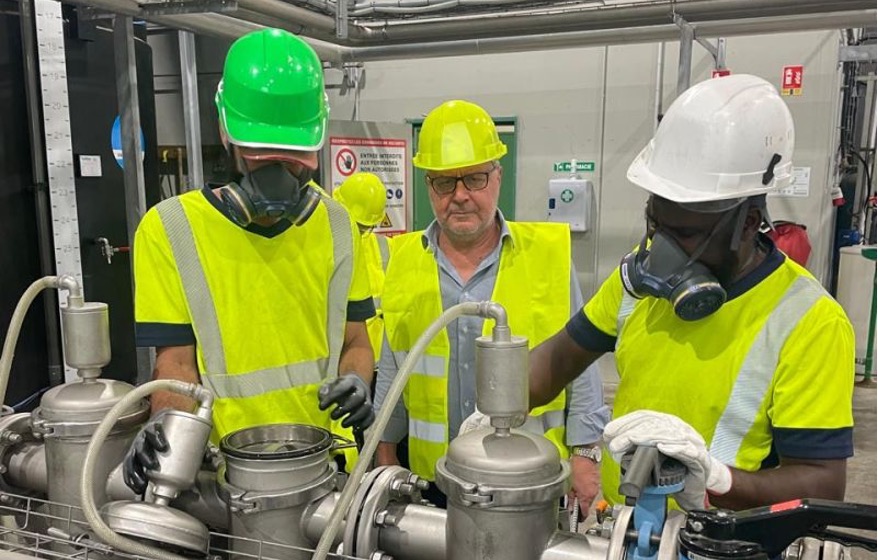
Our senior consultant, on-site during the certification audit.
The Challenge: Pushback, Timeline Pressure, and Hidden Complexity
When we presented the roadmap—"You need ISO 9001 first"—the client’s initial reaction was predictable: concern about timeline extension, frustration about "extra" work, and skepticism about whether this was necessary.
From the client’s perspective, this looked like scope creep and added cost. They had a deal on the line, and we were telling them the path was longer than expected.
But here’s what was really happening: The client faced several interconnected challenges that only became visible once we started digging:
1. Capability vs. Compliance Gap
The factory could produce high-quality urea solution. Operators understood processes. But none of this was documented, controlled, or auditable. There were no records proving consistency, no traceability, no evidence of quality control. ISO 9001 compliance requires all of this.
2. Regulatory Misalignment
ISO 22241 (the automotive urea standard) and VDA AdBlue certification both require a documented Quality Management System as a prerequisite. Attempting VDA without ISO 9001 would result in audit failure. The client would waste time, money, and damage their credibility with their customer.
3. Timeline Misconception
The client initially believed VDA certification could happen in weeks. In reality, the path was: Gap Assessment → ISO 9001 Foundation → Equipment/Process Alignment → ISO 22241 Gap Analysis → VDA Audit. Rushing would mean failure.
4. Resource Constraints
The internal team lacked expertise in quality system design and audit preparation. Building this capability internally would take 12-18 months—if they got it right. They didn’t have that time.
The Strategic Pivot: Reframing Delay as Advantage
Instead of presenting ISO 9001 as an obstacle, we repositioned it as the foundation for a stronger, faster path to VDA certification—and ongoing competitive advantage.
Here’s how we framed it to the client:
"ISO 9001 isn’t a detour. It’s the infrastructure that VDA AdBlue requires. By building this foundation now, you’ll not only achieve VDA certification faster and with higher confidence, but you’ll also have a documented quality system that your customers can audit, that supports continuous improvement, and that positions you for future certifications or customer requirements. Two birds. One stone."
The client agreed. The investment in a proper foundation made business sense.
The Implementation Journey: From Idea to Certification (and Beyond)
What followed was a structured, phased approach spanning from September 2023 through February 2026:
Phase 1: Discovery & Gap Assessment
- Initial compliance assessment based on IATF and VDA standards
- Identified the scope of work needed: ISO 9001 foundation, equipment changes, process documentation
- Established realistic timeline and resource requirements
- Built stakeholder alignment
Phase 2: ISO 9001 Foundation & Equipment Investment
- Designed and documented quality management system aligned with ISO 9001:2015
- Guided equipment upgrades and process changes required for compliance
- Trained internal team on QMS principles and documentation requirements
- Prepared organization for third-party certification audit
Phase 3: ISO 9001 Certification Audit
- On-site support during third-party certification audit
- Pro QC consultant embedded to address auditor questions in real-time
- Result: Successful ISO 9001 certification achieved
- Internal team now owns and understands the QMS framework
Phase 4: ISO 22241 & VDA Alignment
- Gap analysis between ISO 9001 and ISO 22241 standards
- Equipment and process validation for urea solution production
- Documentation translation and VDA audit coordination
- Ongoing corrective action management
- VDA AdBlue certification preparation underway
Why This Timeline Mattered (And Why It Would Have Failed Faster)
If the client had pursued VDA directly without ISO 9001, here’s what would have happened:
- Audit failure: VDA auditors would have rejected the QMS as non-compliant with prerequisite standards
- Rework costs: The client would have been forced to build ISO 9001 afterward—costing more time and money
- Customer credibility damage: Missing deadlines or failing audits would have jeopardized the major customer opportunity
- Operational disruption: Emergency implementation under pressure creates poor quality systems and staff resistance
Instead, by following the structured roadmap, the client:
- Built a compliant ISO 9001 system that actually works operationally
- Positioned themselves confidently for VDA certification
- Created documented processes that reduce defects and support continuous improvement
- Established a foundation for future certifications or customer audits
Key Results & Business Impact
Achieved to Date:
- ✓ ISO 9001:2015 certification obtained (March 2025)
- ✓ Documented quality management system now embedded in daily operations
- ✓ Equipment upgrades and process changes validated and controlled
- ✓ Internal team trained and capable of maintaining QMS independently
- ✓ ISO 22241 gap analysis completed; corrective actions in progress
In Progress:
- VDA AdBlue certification audit scheduled for Q2 2026
- Corrective actions aligned with VDA auditor requirements
- Documentation translation and audit coordination managed
- Client positioned to successfully pass VDA certification
Business Outcomes:
- Major customer opportunity still on track
- Market share expansion enabled by dual certification (ISO 9001 + VDA AdBlue)
- Process documentation reduces operational risk and supports quality consistency
- Internal capability built—less dependency on external consultants for routine QMS maintenance
- Competitive advantage: Few manufacturers of urea solution have both certifications; this differentiates them in the market
The Lesson: Why "Shortcuts" Cost More
This case study illustrates a critical insight that many manufacturers miss: Compliance and competition aren’t separate paths. The systems you build for compliance become the systems you use for operational excellence.
Companies that try to skip ISO 9001 and jump straight to VDA, IATF, or other advanced certifications often face:
- Extended timelines due to audit failures and rework
- Higher total costs (failed audits + emergency implementation + corrective actions)
- Staff frustration and resistance to poorly designed systems
- Damage to customer relationships and credibility
- Missed opportunities because certification delays push back customer deadlines
Conversely, companies that invest in a strong ISO 9001 foundation first:
- Achieve advanced certifications faster and with higher first-pass success rates
- Build systems that staff understand and follow (because they’re designed for the business, not just compliance)
- Create operational efficiencies that reduce defects, waste, and costs
- Position themselves for future customer requirements and certifications
- Establish a competitive advantage through documented quality and process control
Beyond Certification: The Ongoing Partnership
The relationship between Pro QC and this automotive aftertreatment manufacturer didn’t end with ISO 9001 certification. As the company prepares for VDA AdBlue certification and beyond, Pro QC continues to provide:
- On-site audit support during VDA certification
- Corrective action management and closure
- Post-certification QMS maintenance and continuous improvement
- Strategic guidance on future compliance requirements
This ongoing partnership reflects a fundamental principle: certification is a milestone, not a destination. The real value lies in building a quality system that works for the business over time—one that supports growth, reduces risk, and evolves with the company’s needs.
Key Takeaway for Manufacturers & Buyers
If you’re pursuing any advanced certification (VDA, IATF, MDSAP, ISO 13485, etc.), ask yourself: Do I have a robust ISO 9001 foundation in place?
If the answer is no, that’s not a problem—it’s an opportunity. Starting with the right foundation accelerates your path to advanced certification, reduces the risk of audit failure, and builds capability that serves your business long-term.
The best time to build a quality system is before you need it. The second-best time is now.
Ready to evaluate your compliance roadmap?
Schedule a 30-minute consultation with an expert to assess where you stand and what’s needed to achieve your certification goals.