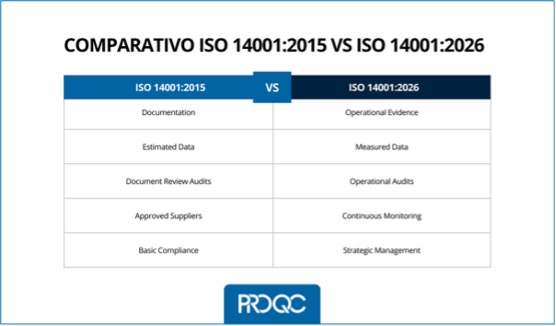
The update to ISO 14001:2026 introduces significant changes in the level of rigor required for environmental management systems: deeper climate risk management, traceable and verifiable data, and stricter control over the supply chain.
This means the standard is shifting away from a documentation-focused approach and now demands technical evidence and operational consistency, aligning with increasing regulatory and market expectations, especially in the U.S. and Europe.
The companies that will face the greatest challenges are those with well-documented systems but low operational integration, reliance on estimated data, or limited visibility over their suppliers.
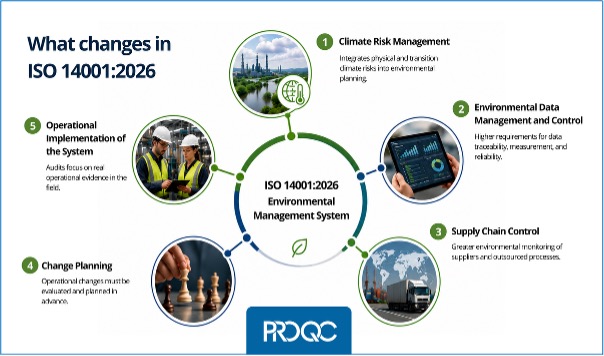
What changes in ISO 14001:2026?
1. Climate risk management as a requirement in ISO 14001:2026
Climate change is no longer treated as a general context but becomes an assessable element within the system. It is no longer sufficient to mention it in the context analysis; now organizations are expected to:
- Identify specific climate risks (both physical and transitional)
- Assess their impact on operations, logistics, and business continuity
- Integrate these risks into environmental planning
In an audit, this translates into difficult questions if there is no solid backing:
- What impact would a prolonged drought have on your water consumption?
- What would happen to your operations if emissions regulations change in your target market?
Companies that have not translated these scenarios into concrete data and plans may be exposed.
2. Environmental data management and control in ISO 14001:2026
This is a major shift. The standard raises the level of requirements regarding data quality:
- Measured data is prioritized over estimations
- Traceability is required (source, method, frequency)
- Consistency between internal and external reporting is expected
In simple, practical terms: if your environmental indicator cannot be explained step by step, it is not reliable.
It is common to find organizations with well-designed dashboards but little clarity on how the numbers are built. Under ISO 14001:2026, this is no longer acceptable.
3. Supply chain control in ISO 14001:2026
One of the most relevant changes is the expansion of scope toward the supply chain.
It is no longer just about having a list of approved suppliers. Now it is expected:
- Environmental evaluation with clear and comparable criteria
- Ongoing monitoring of critical suppliers (not just initial approval)
- Evidence of control over outsourced processes
This directly impacts companies exporting to markets such as the United States or the European Union, where regulatory pressure on supply chains continues to increase.
In an audit, it looks like this:
- How do you know your supplier complies with environmental requirements?
- What evidence do you have beyond a signed declaration?
4. New clause on change planning in ISO 14001:2026
The new standard introduces Clause 6.3 related to change planning, requiring that any changes affecting or potentially affecting the environmental management system be carried out in a planned manner.
As guidance for organizations, examples such as new products, facilities, technological advancements, changes in suppliers, mergers, or supply chain disruptions are included in the official document of the new version.
5. Operational implementation of the system in ISO 14001:2026
This is probably the most structural change in the new version of ISO 14001:2026.
The environmental management system is no longer assessed as a set of documents but as part of the actual operational workflow:
- Procedures aligned with what truly happens on-site
- Operational personnel aware of environmental controls
- Evidence of application, not just definition
In other words, auditing shifts from being primarily document-based to field-based, where it becomes evident whether the system is truly implemented or only defined.
How to prepare for ISO 14001:2026?
- Conduct a diagnosis of your current system:
Evaluate your system against the new ISO 14001:2026 requirements. Identify gaps in three critical areas: risk management, data reliability, and supplier control. Prioritize those gaps that directly impact operations or regulatory compliance.
- Ensure environmental data reliability:
Clearly define how your indicators are generated: data source, measurement method, and frequency. Replace unjustified estimates with measured data and ensure consistency between internal and external reporting.
- Implement environmental risk management:
Identify relevant environmental risks, including climate risks, and assess their impact on operations. Establish specific controls and assign responsibilities for each risk, ensuring clear follow-up actions are in place.
- Strengthen supply chain control:
Classify your suppliers according to environmental risk level. Define evaluation criteria and request verifiable evidence of compliance. Establish monitoring mechanisms for critical suppliers beyond initial approval.
- Integrate the system into operations:
Align procedures with real on-site activities. Verify in the field that defined controls are being applied and that personnel understand their responsibilities within the system.
- Train personnel in system execution:
Develop training focused on practical application. Ensure staff understand how their activities impact environmental aspects and how to implement defined controls.
Conclusion
ISO 14001:2026 maintains the structure of the standard but increases the depth and rigor of its application.
What could previously be sustained with well-structured documentation now requires support through data, execution, and operational consistency.
Clients, regulators, and audits are evaluating the real implementation of the system, not just its documented definition.
Organizations that already have operational control, management discipline, and visibility over their processes will be able to adapt more smoothly to this update. In contrast, those with gaps between documentation and execution will need to undertake deeper adjustments to achieve real alignment between their management system and operations.
About Pro QC
The transition to ISO 14001:2026 requires a thorough review of the environmental management system, particularly in its operational application and across the supply chain.
With over 40 years of experience in quality control and supply chain assurance, Pro QC International has developed a strong track record in conducting environmental management system audits based on ISO 14001.
Through on-site audits, our team provides visibility into the real implementation of the system, identifying gaps between documentation and execution, operational risks, and improvement opportunities that are not always visible at a documentation level.
This approach allows organizations to better understand their maturity level and prepare in a more structured way for audits and new levels of requirement.
Learn more about Pro QC’s ISO 14001 audits.
FAQ – Frequently Asked Questions about ISO 14001:2026
When does ISO 14001:2026 come into force?
ISO 14001:2026 was officially published on April 15, 2026, initiating a three-year transition period for organizations certified under the previous version ISO 14001:2025.
What really changes in ISO 14001:2026?
The level of rigor increases in three key areas: climate risk management, environmental data reliability, and supplier control. Clear evidence is now required on how these aspects are managed in operations, not just in documentation.
Is it necessary to update certification immediately?
Not immediately, but it must be done within the established timeframe. The key is not to treat the transition as a last-minute task, as some adjustments—especially operational ones—require time to be properly implemented.
What types of companies may face more difficulties with this update?
Primarily those with low levels of operational implementation, limited use of verifiable data, or insufficient control over their suppliers.
Will it be necessary to completely redesign the system?
In most cases, no. It will be sufficient to adjust and strengthen existing elements, ensuring their proper application in operations.
Download the ISO 14001:2026 Readiness Checklist
Enter your email address and receive the ISO 14001:2026 readiness checklist directly in your inbox.